I have spent a lot of summers in Colorado chasing wildflowers with a camera. Some trips were perfectly timed. Others I showed up a week too early or a week too late and the meadows were either not quite there yet or already fading. Timing is everything with wildflowers and Colorado makes it complicated because the bloom window at different elevations can vary by weeks.
One thing worth knowing for 2026 specifically: Colorado had a below average snowpack year. That usually means bloom cycles shift earlier at higher elevations. If you are planning a summer trip do not assume the timing will be the same as past years. Check local trail reports before you go and plan to be out earlier in the season than you might expect.
When Does Wildflower Season Peak in Colorado?
The short answer is it depends on where you are going. Colorado wildflower season runs from May through August depending on elevation. Here is a rough breakdown:
Lower elevations (5,000 to 7,000 ft)
Blooms start in May and peak around late June into early July. Foothill regions and open valley floors are your best bet early in the season before the alpine stuff opens up.
Mid elevations (8,000 to 10,500 ft)
This is where most of the iconic Colorado wildflower photography happens. Peak bloom is typically late June through late July. Crested Butte, the San Juans and Steamboat Springs all fall into this zone.
High alpine (above 9,500 ft)
Peak bloom from mid-July through early August in a normal year. In a low snowpack year like 2026 expect this window to shift earlier. Rocky Mountain National Park, the Maroon Bells and the high trails above Crested Butte all fall here.
Best Locations to Photograph Colorado Wildflowers
Crested Butte
Crested Butte is officially the Wildflower Capital of Colorado and it genuinely earns it. The valley and surrounding trails turn into a sea of yellow sunflowers, purple columbine, blue lupine and red paintbrush from July through early August. Trail 403 is one of my personal favorites. Even just a mile or two up you are already surrounded by wildflowers with incredible mountain views in every direction. There is a bench sitting right in the middle of the mountains overlooking the valley that is one of the most peaceful spots I have found in Colorado. It is worth the hike just to sit there for a while.
Rocky Mountain National Park
RMNP offers wildflower viewing across a huge range of elevations. The Cub Lake and Pool Loop is a solid mid-elevation option with dozens of wildflower varieties in July. For high alpine wildflowers the trails above treeline offer stunning displays in mid to late July. The park requires timed entry permits during peak season so plan ahead and book early.
San Juan Mountains near Telluride and Ouray
The San Juans are consistently some of the best wildflower photography in the state. Ice Lakes Trail near Silverton puts you in high alpine terrain with vivid blue-green lakes surrounded by blooms. The area around Telluride has accessible trails with incredible displays from late June through late July. If you have not been to this part of Colorado it is worth the drive.
Maroon Bells near Aspen
One of the most photographed spots in Colorado and for good reason. The combination of the twin peaks, the lake reflection and wildflower-lined trails makes this a must visit for landscape photographers. Peak bloom in the surrounding meadows hits mid to late July. Get there early in the morning to beat the crowds and catch the best light on the peaks.
Photography Tips for Colorado Wildflowers
Bring a tripod
A tripod is one of those things that is easy to leave behind because it adds weight to your pack. Do not skip it for wildflower photography. Even a light breeze will cause flowers to move and blur at slower shutter speeds and getting low to the ground for close-up shots makes a tripod essential for keeping things sharp. I carry a lightweight hiking tripod on any trip where I know I will be shooting flowers. It makes a real difference.
Use a fast shutter speed on windy days
Wind is your biggest enemy when shooting wildflowers. If there is any breeze at all bump your shutter speed up to at least 1/500th of a second or faster to freeze the movement. You will need to raise your ISO to compensate but a slightly noisier sharp image is always better than a soft one. Early morning is almost always the calmest part of the day which is another good reason to get out before everyone else.
Shoot during golden hour
Midday light is flat and harsh and wildflowers shot in direct afternoon sun can look washed out. The hour after sunrise and the hour before sunset are when wildflower photography really comes alive. The warm low angle light adds depth and richness to the colors in a way that midday just cannot replicate. I have shot wildflowers at Crested Butte at sunset and the difference compared to midday is pretty dramatic. Always plan your shoot around the light first. I shoot on a Sony a7III and the dynamic range it handles in those golden hour conditions is genuinely impressive.
Use flowers as foreground interest
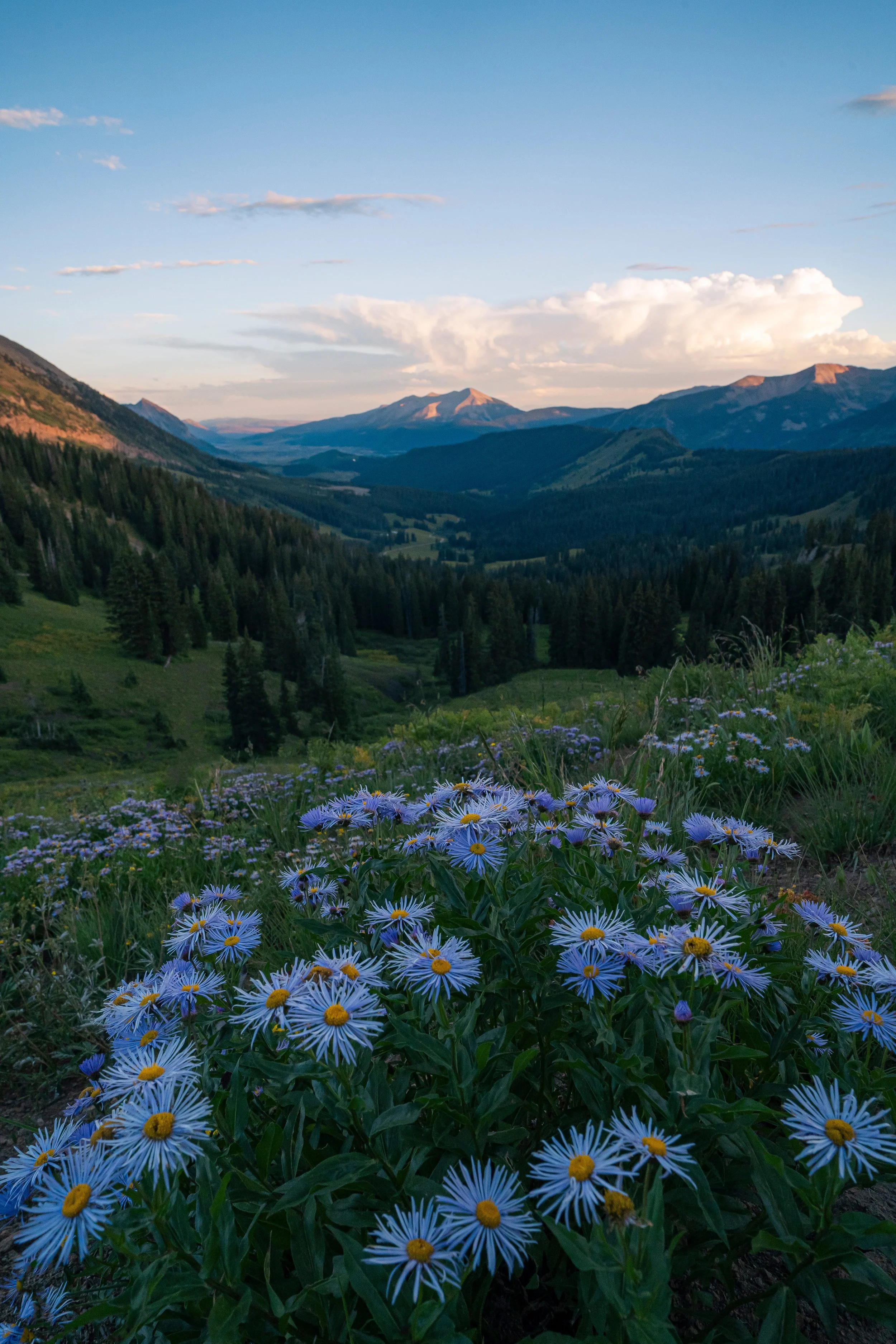
The best wildflower landscape shots are not just photos of flowers. They use the flowers as a foreground element to lead the eye toward a mountain, valley or dramatic sky in the background. Get low, place a strong cluster of flowers in the lower third of the frame and use a wide angle lens to capture both the flowers up close and the landscape stretching behind them. This is the composition style that makes wildflower photos actually look interesting rather than just a field of color.
Try focus stacking for close-up shots
When shooting individual flowers up close you often cannot get the entire flower sharp while also keeping a natural looking background, even at f/11 or f/16. Focus stacking is the fix. Take multiple shots with the focus point shifted slightly between each one then blend them together in Photoshop or Lightroom. The result is a photo with sharp detail throughout the flower while keeping the background natural looking. It takes some practice but once you get the hang of it the results are worth it.
Do not write off overcast days
Overcast skies act like a giant softbox and can produce some of the most beautiful wildflower light. Colors are rich and saturated without harsh shadows and you can shoot throughout the day rather than only at golden hour. Colorado summer afternoons often bring clouds and dramatic skies which can make for incredible backgrounds behind the flowers. Do not pack up just because the sun disappears.
Final Thoughts
Colorado wildflower season is one of those things you have to experience to really understand. The window is short, the timing is unpredictable and the best spots fill up fast. But if you plan around the elevation and timing, get out early and bring a tripod you will come home with shots that are genuinely hard to replicate anywhere else.